
EXPANDED ACCESS OF AN
INVESTIGATIONAL PRODUCT
Expanded Access of an Investigational Product
Andrea Cruz, PhD MS
Clinical and Regulatory Affairs Project Lead, Clinical Research Strategies
December 2025
Introduction
Patients with complex medical cases of unknown disease etiologies and indeterminate diagnoses often face the harsh reality that few, if any, commercially available treatment options exist to stabilize their health or prevent further deterioration. Most of these patients have progressive, sometimes rapid, onset of physical and/or cognitive decline. The emotional toll, caregiver requirements, and out-of-pocket expenses paid in pursuit of treatment or palliative care represent a significant personal burden.
Expanded Across Program
The U.S. Food and Drug Administration (FDA) Expanded Access (EA) program (often referred to as compassionate use) was initiated to provide a regulatory framework for patients with serious or life-threatening diseases or conditions to safely access investigational medical products outside of a clinical trial when no comparable or satisfactory alternative treatment exists. The EA program was first established and codified into regulations for drugs and biologics in 1987 and for devices in 1996. Through the EA program, tens of thousands of patients with serious or life-threatening conditions, who have exhausted all or have no alternative treatment options, have been able to safely access potentially beneficial, investigational therapies. The EA program continues to evolve and refine itself based on stakeholder feedback. The EA program has simplified documentation requirements and streamlined Institutional Review Board (IRB) requirements, thus aligning itself to be more patient-centered, efficient, flexible, and responsive. (1,2)
21st Century Cures Act
The 21st Century Cures Act, signed into law in 2016, requires manufacturers of investigational drugs and biologics (and implicitly, devices) to make their EA policies readily available on a public website. Manufacturers fulfill this requirement by posting their EA policy directly on their website or through the Reagan-Udall Foundation’s Expanded Access Navigator (https://navigator.reaganudall.org/). Manufacturers are not required to offer or participate in an EA program, but publicly posting policies promote transparency, consistency, realistic expectations, and make it easier for patients and clinicians to explore emerging treatment options. (3,4)
Right-to-Try
In 2018, the federal Right To Try Act went into effect in the U.S. creating an additional, more permissive route for terminally ill patients to gain access to investigational drugs outside clinical trials. (5) Existing in parallel to the EA program, the Right To Try legislation allows individuals who meet the strict eligibility criteria to appeal directly to the manufacturer of an investigational drug or device, which must have completed phase 1 clinical trials. The right-to-try pathway is not overseen by the FDA nor does it require IRB approval, but some regulations must still be followed. The manufacturer must report the number of doses provided, the indication, and any serious adverse events observed to the FDA through an Investigational New Drug (IND) annual report. Similar approaches and methods are permissible for the use of medical devices, including those under Investigational Device Exemptions (IDEs). (6)
Not without controversy, the manufacturer may stand at odds with agreeing to an individual’s request due to concerns over the risk-benefit profile, limited efficacy and safety data, restricted product supply or high production costs, potential impacts to ongoing clinical trials and continued product development, and liability for harms. To reduce the manufacturer’s perceived risk, terminally ill patients often agree to waive harm, or even death, resulting from experimental treatment and acknowledge there are no guarantees that experimental treatment would be beneficial or extend their life. Under right-to-try, manufacturers are permitted to charge patients for “direct costs” of making the investigational product available to offset some of the financial burden. (7,8,9)
Yet, even when a manufacturer agrees to provide access, the right-to-try pathway remains highly debated. Because FDA and IRB oversight are intentionally removed under the Right to Try Act, no independent body is verifying that patients are appropriately selected, adequately informed, and monitored under the safeguards that ordinarily guide ethical and safe use of investigational products. This gap in oversight creates uncertainty about who, manufacturer or treating physician, assumes responsibility for these essential protections, leaving patients potentially exposed to additional and unforeseen risks. (7,8,9)
Right to try is widely regarded as “Right to Ask” rather than a guaranteed pathway. (7) The Right To Try Act is limited not by statute, but by manufacturer discretion, liability concerns, financial barriers, and debate over appropriate oversight. As such, the FDA EA program remains the primary mechanism for patients with serious or life-threatening conditions to access investigational medical products outside clinical trials. (2,10)
EA PROGRAM CRITERIA
FOR A PATIENT TO QUALIFY FOR EXPANDED ACCESS, A LICENSED PHYSICIAN MUST DETERMINE THAT:

The patient has a serious or immediately life-threatening disease or condition.

There is no comparable or satisfactory alternative therapy to diagnose, monitor, or treat the disease or condition.
Patient enrollment in a clinical trial is not possible.

The potential patient benefit justifies the potential risks of treatment.
ADDITIONALLY, FOR THE FDA TO CONSIDER APPROVAL:

The manufacturer must be willing to provide the drug, biologic, or device.* The FDA cannot require a manufacturer to provide a product.

Provision of the investigational medical product will not interfere with investigational trials that could support a medical product’s development or marketing approval for the treatment indication.
*Note: The manufacturer may decide to charge for the development of its medical product per individual case which is likely to be passed on directly to the patient.
EXPANDED ACCESS FOR DRUGS, BIOLOGICS, AND DEVICES
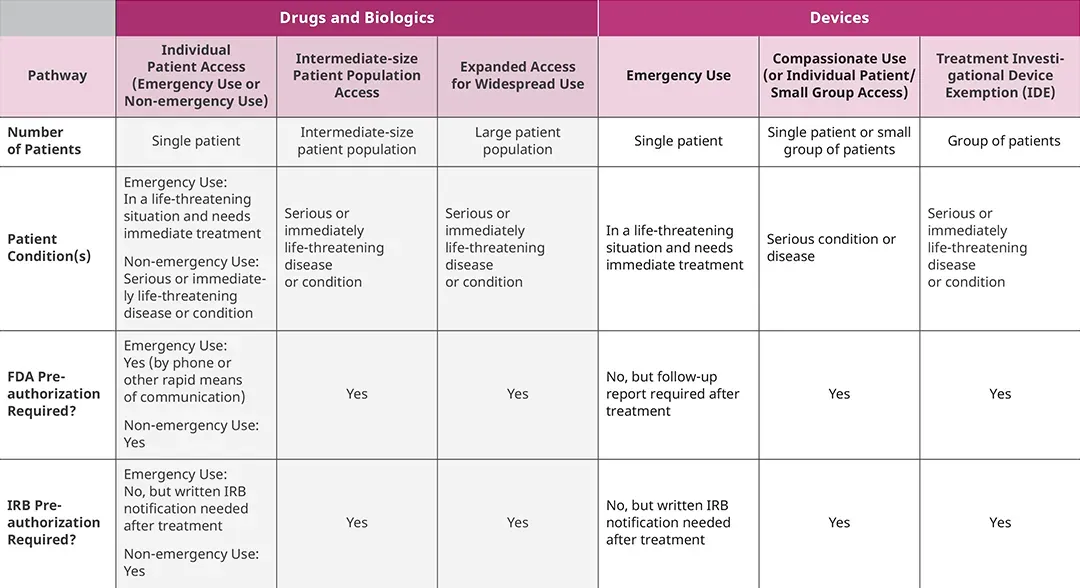
If patient(s) meet the criteria, EA requests for drugs, biologics, and devices are submitted to the FDA either by a licensed treating physician or by the investigational medical product’s manufacturer (Sponsor). While the EA frameworks for drugs/biologics and devices are slightly different, they are structured similarly with three distinct pathways designed to match the level of need (Emergency use or Non-emergency Use) and the number of patients requiring access to the investigational medical product. (11,12)
CRS SERVICES SUPPORTING INDIVIDUAL CASES FOR EMERGENCY USE OR EXPANDED ACCESS
CRS leadership brings two decades of expertise to Sponsors and treating physicians who have trouble navigating the rules and regulations for individual patient cases or who lack the resources to provide assistance to a patient they are treating. Our team of experienced regulatory and clinical professionals has successfully developed Sponsors’ compassionate use / expanded use programs for company-wide and Reagan-Udall website postings, prepared regulatory submissions, facilitated FDA calls and documentation, served as an intermediary with patients, customized informed consent forms and case report forms, and sought IRB approval.
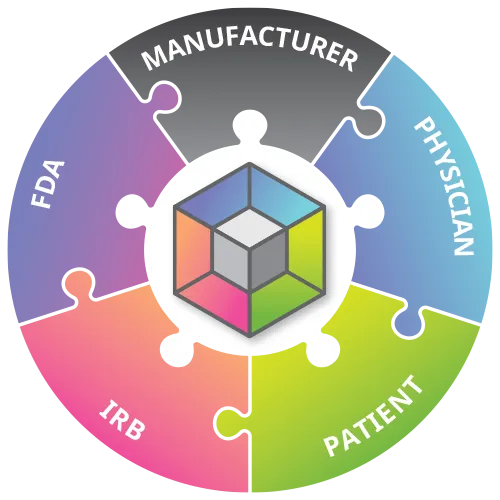
A recent case we supported involved an older adult with an undiagnosed life-long debilitating condition, manifesting as progressive muscle weakness and mobility deterioration. CRS took on the operational, regulatory, and logistical work, giving manufacturer and physician confidence in providing investigational products quickly, safely, and compliantly:
- Expanded Access Program Development: Developed an EA program for the manufacturer, defining internal policies and systems.
- Regulatory Preparation: Prepared FDA submission under an IDE with provision of rationale and justification, physician’s treatment protocol, and customized model informed consent form.
- Regulatory Communication: Facilitated discussion between physician and the FDA.
- Project Management: Served as intermediary between manufacturer, physician, and patient; maintained HIPAA/patient privacy; coordinated timelines; ensured necessary documents are obtained; tracked FDA and IRB approvals and aligned expectations.
- IRB coordination: Assisted physician in managing IRB submission and responded to queries.
- Safety Management: Set up safety reporting processes, including adverse event documentation and reporting workflows.
- Supply and Logistics: Supported investigational product shipment coordination and storage requirements.
- Compliance Oversight: Ensured all activities follow FDA, IRB, and GCP expectations for EA.
- Documentation and Record-keeping: Maintained EA protocol, treatment records and case report forms, regulatory correspondence, and follow-up FDA report.
SUMMARY
Many patients fall through cracks in our healthcare system and have nowhere to turn for help. The regulatory hurdles and nuances to supporting such cases may be overwhelming to both Sponsors and physicians.
CRS is a proven expert partner to ensure the regulations are being met, and the safety and confidentiality of the patient is maintained. Urgent support including weekends and holidays is available for Emergency Use cases. Contact us for more information about ways we can help your organization, medical practice, or an individual patient.
References
- FDA. (2025, September 08). Expanded Access. U.S. Food & Drug Administration. https://www.fda.gov/news-events/public-health-focus/expanded-access
- FDA. (2024, May 02). Expanded Access (Compassionate Use) Submission Data. U.S. Food & Drug Administration. https://www.fda.gov/news-events/expanded-access/expanded-access-compassionate-use-submission-data
- United States Congress. (2015-2016). 21st Century Cures Act, H.R. 34, 114th Cong. https://www.congress.gov/bill/114th-congress/house-bill/34
- FDA. (2020, January 31). 21st Century Cures Act. U.S. Food & Drug Administration. https://www.fda.gov/regulatory-information/selected-amendments-fdc-act/21st-century-cures-act
- United States Congress. (2018). Trickett Wendler, Frank Mongiello, Jordan McLinn, and Matthew Bellina Right to Try Act of 2017, S. 204, 115th Cong. https://www.congress.gov/bill/115th-congress/senate-bill/204
- FDA. (2024, December 12). Right to Try. U.S. Food & Drug Administration. https://www.fda.gov/patients/learn-about-expanded-access-and-other-treatment-options/right-try
- Hudis, C. (2018, July 09). Right-to-Try: A Conversation With Dr. Richard L. Schilsky. ASCO Connection. https://connection.asco.org/do/right-try-conversation-dr-richard-l-schilsky
- Shoemaker, D., Barber, K., and Whitney, K. (2019, August 05) Right-to-try or right to ask? Rho. https://www.clinicalleader.com/doc/right-to-try-or-right-to-ask-understanding-right-to-try-and-fda-s-expanded-access-programs-0001
- Miseta, E. (2018, November 29). Now That Right To Try Is Law, What Does It Mean To You? Clinical Leader. https://www.clinicalleader.com/doc/now-that-right-to-try-is-law-what-does-it-mean-to-you-0001
- FDA. (2025, July 09). Right to Try Annual Reporting Summary. U.S. Food & Drug Administration. https://www.fda.gov/patients/learn-about-expanded-access-and-other-treatment-options/right-try-annual-reporting-summary
- FDA. (2018, January 04). Expanded Access Categories for Drugs (Including Biologics). U.S. Food & Drug Administration. https://www.fda.gov/news-events/expanded-access/expanded-access-categories-drugs-including-biologics
- FDA. (2019, June 21). Expanded Access for Medical Devices. U.S. Food & Drug Administration. https://www.fda.gov/medical-devices/investigational-device-exemption-ide/expanded-access-medical-devices#compassionate
ABOUT THE AUTHOR
Andrea Cruz, PhD MS
Clinical and Regulatory Affairs Project Lead
As a Project Lead, Andrea assists in regulatory strategy and clinical trial management, helping clients efficiently launch and run their studies. Her passion lies in driving new therapies from concept to clinic for a range of therapeutic indications with a particular interest in neuropathologies, oncology, and expanded access / compassionate use cases where patients urgently need options.
Andrea earned her Master of Science (MS) degree in Toxicology at the University of Michigan School of Medicine, where she conducted research in environmental toxicants and their impact on the development of limbs and early nerve structures. She later pivoted to cancer research and earned her doctorate in Cellular and Molecular Pathology from the University of Pittsburgh School of Medicine, where she conducted research in the identification of novel drug targets and biomarkers in pediatric brain tumors, resulting in several peer-reviewed publications.

ANDREA CRUZ, PhD MS
Clinical and Regulatory Affairs Project Lead